
The cement industry, one of the most established and strategically critical sectors globally, is currently undergoing one of the most significant phases of digital transformation. High temperature clinker processes, variable raw material compositions, multi-stage production with delayed quality feedback, and energy intensive operations make cement production a highly complex system.
Rising energy costs, tightening environmental regulations, and carbon reduction targets are driving producers toward more predictable, data driven, and adaptive decision-making mechanisms. In this context, artificial intelligence is not merely a technology that enhances automation; it has emerged as a strategic enabler that strengthens process stability and delivers sustainable efficiency.
As highlighted in the Net Zero Industry Tracker 2024 report by the World Economic Forum (WEF), digitalization, advanced process control (APC), and AI-based optimization solutions in the cement industry are among the most effective early-stage levers in the net-zero transition.
As one of the global cement and building materials producers, Çimsa adopts a proactive approach leveraging data analytics, process optimization, and low carbon product strategies not only to follow but to lead this transformation. Our Operational Technologies division forms the backbone of this transformation by converting high volume plant data into actionable insights. Through these systems, a technology driven and holistic management culture is established across all layers of production.
Below, we examine the key implementation areas and the operational gains achieved in this digital transformation journey.
Process Optimization: Intelligent Decision Systems in Rotary Kilns
The rotary kiln, the core of cement production, presents a challenging environment for conventional control systems due to continuously changing raw material chemistry and thermodynamic balance. Traditional PID control systems are effective in short-delay processes; however, cement production involves multivariable systems with long response times.
At this point, AI and Model Predictive Control (MPC) based advanced control systems:
- Optimize kiln temperature and oxygen levels
- Balance fuel-to-air ratios
- Stabilize grinding fineness
- Reduce process fluctuations
Machine learning algorithms not only analyze the current state but also predict the process behavior 30–60 minutes ahead. By transforming operator experience into mathematical models, these systems enable balanced integration into operational workflows.
International studies indicate that AI-supported kiln optimization can achieve:
- 2–5% increase in capacity
- 1–3% reduction in specific energy consumption
These improvements also directly contribute to carbon emission reduction.
The referenced figure illustrates the impact of AI based process optimization on production performance in a vertical raw mill line. Starting from manual operation, the process evolves through hardware improvements, advanced process control, and AI-driven asset optimization.
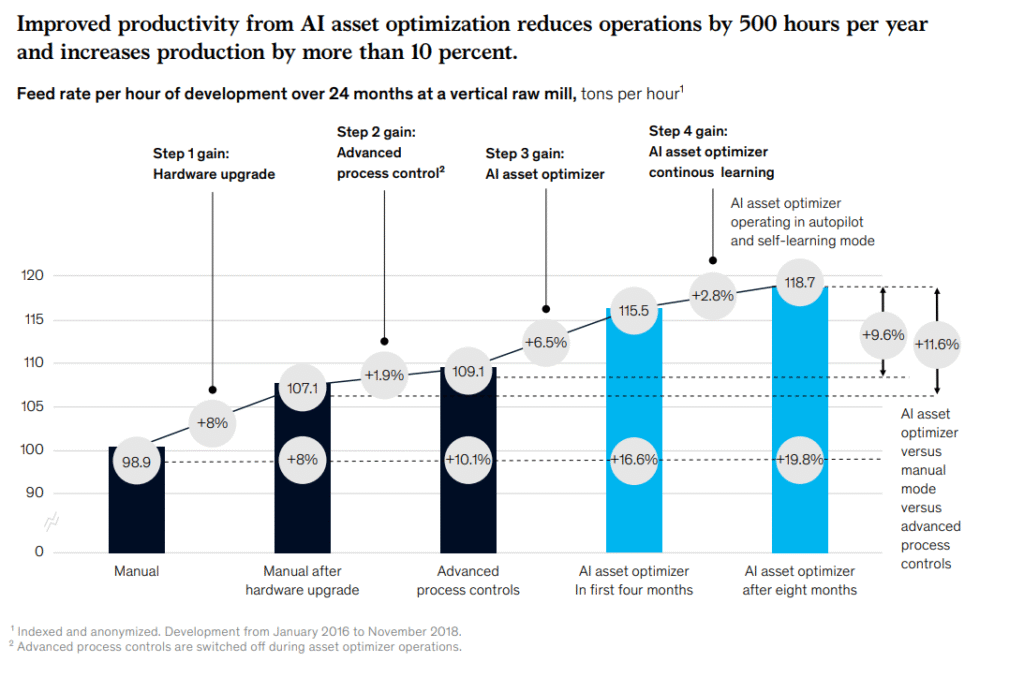
Figure 1: An example illustrating the positive impact of artificial intelligence and advanced process control approaches on production performance and operational continuity in a raw milling line.
With continuous learning enabled, more than a 10% increase in hourly throughput was achieved, while annual operational time was reduced by approximately 500 hours. These results demonstrate that AI is not merely an automation tool but a strategic lever for process stability and sustainable efficiency.
Predictive Maintenance: Preventing Unplanned Downtime
Unplanned shutdowns in cement plants result in significant operational and financial losses. However, equipment failures rarely occur suddenly; they are typically preceded by small but persistent deviations in vibration, temperature, and current signals.
With cloud-based data infrastructure and machine learning driven centralized monitoring platforms, all critical equipment can be continuously monitored from a single interface. This approach enables not only real time monitoring but also trend analysis and effective decision support based on historical data.
Predictive maintenance applications:
- Decompose motor vibration spectra using Fourier analysis
- Analyze behavioral trends via time-series models (e.g., LSTM;Long Short-Term Memory networks)
- Convert anomalous patterns into early warning mechanisms
According to studies by Deloitte and ABB:
- Unplanned downtime can be reduced by 30–50%
- Maintenance costs can be reduced by 10–15%
Predictive maintenance therefore serves not only as a maintenance optimization tool but as a critical operational lever ensuring production continuity, extending equipment life, and improving energy efficiency.
Real-Time Quality Management: Strength Prediction Approach
In cement production, quality is not merely an output determined by final product testing; it is the result of a multi-layered quality assurance system spanning raw material preparation, clinker, and grinding.
Numerous parameters such as XRF/XRD analyses, online analyzers, blaine fineness, free lime (f-CaO), and temperature profiles are continuously monitored. Operators and quality teams intervene in real time, while product compliance is evaluated based on process stability, chemical composition, and historical performance rather than a single test result.
Historically, indirect indicators such as:
- C₃S ratio
- Blaine fineness
- Setting behavior
- Early-age strength (2–7 days) have been used to estimate 28-day strength.
However, these are largely based on operator experience and correlation based interpretation, which limits consistency due to the dynamic and multivariable nature of the process.
Machine learning models do not replace existing quality control systems but enhance and complement them.
These models use inputs such as:
- Clinker mineral phases (C₃S, C₂S, C₃A, C₄AF)
- Blaine fineness
- Additive ratios
- Kiln temperature profiles
and can accurately predict:
- 2, 7, and 28-day strength values
Literature reports that AI models can predict concrete strength with an accuracy of 2–5% MAE. This transforms quality from a retrospective validation metric into a predictive and actively manageable parameter.
SmartCem: Proactive Quality Management via Data-Driven Strength Prediction
Developed through Çimsa’s R&D and Operational Technologies expertise, the SmartCem model analyzes process and quality data holistically to predict 28-day cement strength in real time.
By evaluating multiple parameters simultaneously, the model enables early insight into delayed quality feedback, supporting proactive decision-making. This approach transforms quality control into a data-driven, proactive management system that enhances production stability, supports mix design optimization, and enables early detection of quality risks.
Energy Management and Carbon Reduction
Approximately 6.5% of global CO₂ emissions originate from cement production, highlighting the sector’s significant transformation potential.
At Çimsa, data, technology, and innovation form the foundation of our production approach. While AI is not a direct emission reduction tool, it contributes indirectly yet measurably through integration with renewable energy systems and waste heat recovery.
Key mechanisms include:
- Fuel-air ratio optimization
- Alternative fuel balancing
- Clinker factor reduction
- Stabilization of energy consumption
Reports by IEA and Siemens indicate that digital optimization systems can deliver up to 5% energy efficiency improvements in heavy industry, leading to meaningful annual carbon reductions depending on plant scale.
Data-Driven Logistics and Supply Chain Planning
Logistics costs constitute a significant portion of total costs in cement transportation due to its heavy and bulk nature.
AI algorithms analyze historical shipment data, order frequency, customer locations, and operational constraints to:
- Dynamically determine optimal transport routes
- Optimize delivery times and load efficiency
- Balance inventory levels via demand forecasting
- Reduce fuel consumption
For globally distributed operations like Çimsa, these systems go beyond static planning, offering continuously updated decision-making aligned with changing demand and field conditions. This approach enhances cost efficiency, reduces logistics-related emissions, and improves customer satisfaction.
Digital Twin: Risk Management via Virtual Factory
Industrial decision-making is undergoing a fundamental shift. With digital twin technology, production processes are no longer tested through real world risk taking but are first modeled and validated in virtual environments.
This “virtual factory” approach, continuously fed by real time data, enhances process stability and enables efficiency and sustainability goals.
Çimsa’s digital twin application analyzes production lines holistically using data driven simulations and 3D modeling. It enables not only real-time monitoring but also scenario-based evaluation.
Example:
“What would be the impact on clinker quality and process stability if the fuel ratio increases by 3%?”
Such scenarios are first tested virtually to minimize risks, followed by controlled implementation in real operations. This transforms decision-making from experience-based to measurable and predictable.
Çimsa Perspective: A Low Carbon Future Driven by Data
According to WEF, approximately 75% of carbon reduction in cement is expected to come from operational efficiency, material efficiency, and process improvements all linked to AI and advanced analytics.
At Çimsa, digital transformation is not only about operational efficiency. Utilizing our R&D centers in Mersin (Türkiye) and Munich (Germany), we are positioning low carbon product development as a strategic priority.
Key focus areas:
- Low clinker factor cement formulations
- Alternative binder technologies
- Energy reduction via process stabilization
- Sustainable product design through data-driven quality prediction
Especially in specialty cement and calcium aluminate products, data analytics plays a critical role in achieving high early strength and low-carbon performance optimization.
The Cement of the Future: Less Carbon, More Data
AI applications are transforming every stage of cement production from process optimization and quality prediction to predictive maintenance and carbon reduction. The future of cement production will not be defined by higher temperatures, but by higher data intelligence. Competitive advantage will increasingly depend not on capacity alone, but on the ability to analyze data and translate it into optimal decisions. At Çimsa, we aim to be at the center of this transformation driving heavy industry toward a data driven, low carbon, and sustainable future. And we are building this future with data.
This article outlines the strategic framework of the transformation initiated by data and artificial intelligence in the cement industry. However, the real impact of this transformation becomes evident in field applications and engineering details. In our next article, you can explore the practical implications and engineering dimensions of this transformation in depth.
Resources
- World Economic Forum (WEF) – Net-Zero Industry Tracker 2024: Cement
- International Energy Agency (IEA), Cement Sector Emissions Report, 2023
- McKinsey & Company, Digital in Heavy Industry, 2023
- World Economic Forum, Industrial AI Transformation Report, 2022
- Deloitte Insights, Predictive Maintenance in Industrial Operations, 2022
- Cement & Concrete Research Journal, Machine Learning in Strength Prediction, 2021
Frequently Asked Questions
How is artificial intelligence used in cement production?
Artificial intelligence is applied across cement production in process optimization of rotary kilns, predictive maintenance of critical equipment, real-time quality management through strength prediction, energy management and carbon reduction, data-driven logistics planning, and digital twin simulations. It converts high volume plant data into actionable insights, strengthening process stability and delivering sustainable efficiency beyond conventional automation.
What do AI and Model Predictive Control systems achieve in rotary kilns?
AI and Model Predictive Control (MPC) based systems optimize kiln temperature and oxygen levels, balance fuel-to-air ratios, stabilize grinding fineness, and reduce process fluctuations. Machine learning algorithms predict process behavior 30-60 minutes ahead. International studies indicate AI-supported kiln optimization can achieve a 2-5% increase in capacity and a 1-3% reduction in specific energy consumption.
What is predictive maintenance in cement plants?
Predictive maintenance uses cloud-based data infrastructure and machine learning platforms to continuously monitor critical equipment for deviations in vibration, temperature, and current signals. Applications decompose motor vibration spectra with Fourier analysis and analyze trends via time-series models such as LSTM networks. Studies by Deloitte and ABB show unplanned downtime can be reduced by 30-50% and maintenance costs by 10-15%.
What is SmartCem and how does it predict cement strength?
SmartCem is a model developed through Çimsa’s R&D and Operational Technologies expertise that analyzes process and quality data holistically to predict 28-day cement strength in real time. By evaluating multiple parameters simultaneously, it provides early insight into delayed quality feedback, supports proactive decision-making, enhances production stability, and enables early detection of quality risks.
What is a digital twin in cement manufacturing?
A digital twin is a virtual factory continuously fed by real-time data, in which production processes are modeled and validated before real-world implementation. Çimsa’s digital twin analyzes production lines holistically using data-driven simulations and 3D modeling, enabling scenario-based evaluation, such as testing how a 3% fuel ratio increase would affect clinker quality and process stability.